AI Workflows and Decision Intelligence: Transforming Legal Tech for 2026
- SavvyLex

- Jan 13
- 4 min read
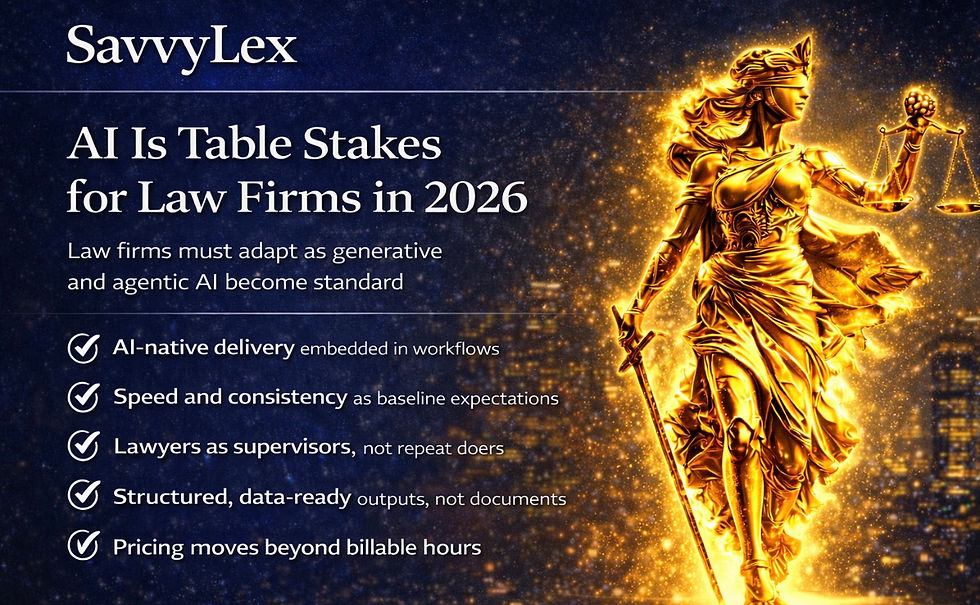
The legal technology market is evolving rapidly, moving beyond simple AI features toward fully integrated AI systems that support workflows, traceability, and governance. This shift is especially clear in areas like legal research, document drafting, risk management, and compliance within regulated industries. Recent product updates from leading vendors highlight how AI is becoming embedded in end-to-end processes, helping law firms, legal teams, and compliance leaders produce more reliable and defensible work.
This post breaks down the most important developments in legal tech for early 2026 and explains what they mean for legal professionals aiming to improve efficiency, accuracy, and oversight.
AI Moves from Standalone Tools to Integrated Workflows
The biggest trend in legal tech this year is the transition from AI as a feature to AI as a system that powers entire workflows. Instead of just assisting with isolated tasks, AI now supports repeatable, auditable processes that produce consistent results.
Recent Developments
Thomson Reuters expanded its CoCounsel platform with a new “Know Your Judge” feature for U.S. courts. This addition helps legal teams understand judge tendencies based on prior rulings and fact patterns. They also improved workflows for complaint drafting and jurisdictional surveys, making the drafting process more streamlined and reliable.
Norm Ai launched an agent-based product that automates due diligence questionnaires (DDQ) and request for proposal (RFP) completions. The system pulls information from approved sources, drafts responses, exports them in the required formats, and stores answers for future reuse. This reduces manual effort and ensures consistency.
Panaya introduced an AI-driven system to support testing and analysis during ERP and CRM change cycles. Users interact with the system through natural language, making complex technical processes easier to manage and audit.
Why This Matters
This shift means legal teams move from saying “AI helped me draft something” to having a controlled process that reliably produces defensible work product. AI workflows improve transparency, reduce errors, and make it easier to track how decisions were made, which is critical for compliance and risk management.
Decision Intelligence Emerges as a Key Product Category
Understanding how judges, regulators, and agencies behave is becoming a valuable asset. Legal tech companies are packaging this insight into products that help professionals anticipate decisions and tailor strategies accordingly.
Notable Updates
Ropes & Gray launched the Health AI Atlas, a tool that tracks healthcare AI regulation across states and at the federal level. It provides summaries of common requirements, helping compliance teams stay current with evolving rules.
Thomson Reuters’ “Know Your Judge” feature summarizes judge tendencies by analyzing prior rulings, cited precedents, and fact patterns. This helps lawyers predict how judges might rule on specific issues.
Practical Impact
Decision intelligence tools give legal teams a clearer picture of the regulatory and judicial landscape. This insight supports better risk assessment, more targeted arguments, and improved compliance strategies. It also reduces uncertainty, which can save time and resources during case preparation or regulatory reviews.

How AI Workflows Improve Legal Research and Drafting
Legal research and drafting have traditionally been time-consuming and prone to inconsistencies. AI workflows now automate many steps, from gathering relevant case law to drafting documents that comply with jurisdictional rules.
For example, Thomson Reuters’ enhancements to CoCounsel allow lawyers to draft complaints with built-in jurisdictional surveys. This means the AI not only helps write but also checks that the document meets local legal standards. The system tracks each step, making it easier to review and justify decisions.
Norm Ai’s agentic DDQ/RFP product automates responses based on approved materials, reducing the risk of errors or unauthorized disclosures. It also stores answers for reuse, speeding up future projects and maintaining consistency across teams.
These workflows reduce manual work, improve accuracy, and create a clear audit trail, which is essential for compliance and risk management.
AI Systems Support Risk Management and Compliance
Regulated industries face growing complexity in compliance requirements. AI systems that integrate workflows and decision intelligence help legal and compliance teams manage this complexity more effectively.
Panaya’s natural language interface for ERP/CRM testing is an example of how AI can simplify technical compliance tasks. By allowing users to interact with the system in plain language, it reduces the need for specialized technical knowledge and makes testing more accessible and transparent.
Ropes & Gray’s Health AI Atlas helps compliance leaders track regulatory changes in healthcare AI, providing a centralized source of truth for evolving rules. This reduces the risk of non-compliance and supports proactive risk management.
What Legal Teams Should Do Next
Legal professionals should evaluate their current technology stacks and look for AI solutions that offer integrated workflows and decision intelligence. These systems provide more than just automation—they enable controlled, repeatable processes that improve quality and accountability.
Key steps include:
Identify repetitive tasks that could benefit from AI-driven workflows, such as document drafting or questionnaire completion.
Explore tools that offer decision intelligence to better understand judges, regulators, and agencies relevant to your practice.
Prioritize solutions that provide audit trails and governance features to support compliance and risk management.
Train teams to use AI systems as part of end-to-end processes rather than isolated tools.
Legal technology in 2026 is no longer about adding AI features but about embedding AI into the core of legal workflows. This evolution helps legal teams produce work that is not only faster but also more reliable and defensible. By adopting AI systems with strong workflow integration and decision intelligence, law firms and compliance leaders can better navigate complex legal landscapes and deliver stronger outcomes.


Comments