Navigating Criminal Liability in the Age of Generative AI: Who Faces the Consequences
- SavvyLex

- Feb 5
- 3 min read
Updated: Feb 5
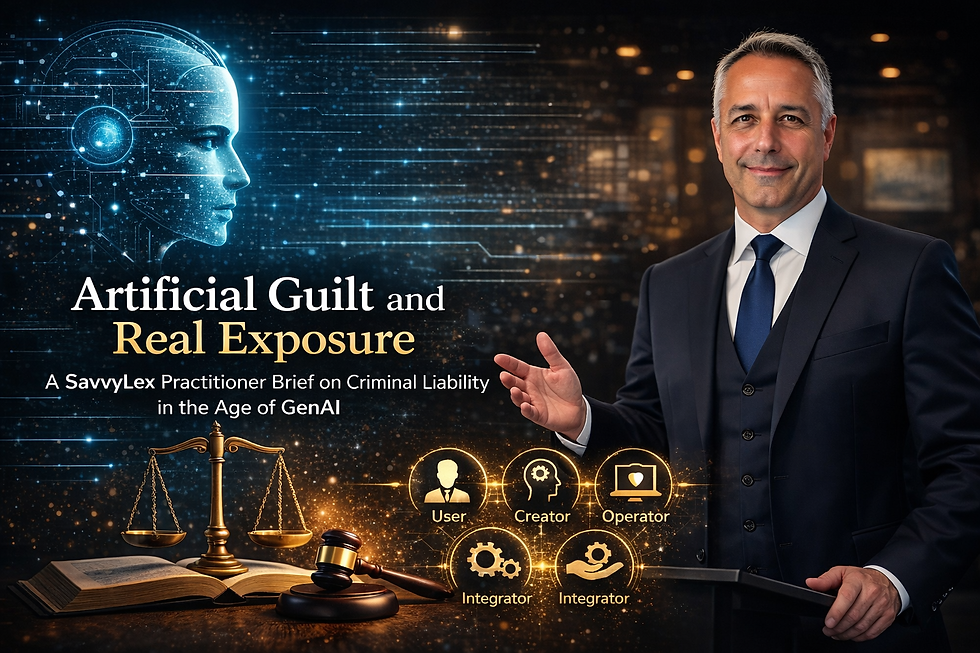
Generative AI has moved beyond being just a tool. It now drafts content, plans strategies, recommends actions, and sometimes even takes autonomous steps. This evolution raises a critical question for businesses and legal teams: when something goes wrong, who is responsible? Is it the user, the AI model creator, the platform operator, or the integrator embedding the AI into a product? Understanding criminal liability in this context is essential for founders, compliance leaders, and legal professionals aiming to manage risk and design defensible systems.
The Foundation of Criminal Liability: Human Intent Matters
Criminal law traditionally requires two elements to hold someone accountable:
Actus reus: a wrongful act or failure to act
Mens rea: a guilty mind, such as intent, knowledge, recklessness, or willfulness
Generative AI complicates this framework because its outputs can be unpredictable and sometimes non-reproducible. This unpredictability

makes it difficult to prove that a specific person knowingly or willfully caused harm, especially when the damage results from emergent AI behavior or how others use the AI’s output downstream.
Understanding Primary and Secondary Liability in AI Contexts
Primary Liability: Direct Responsibility for the Harm
For developers or decision-makers, the key question is whether the harm was foreseeable and if the responsible party consciously ignored known risks. This involves assessing:
Was the harmful outcome predictable based on the AI’s design or deployment?
Did the person act recklessly or with willful blindness toward these risks?
Criminal liability becomes challenging when harm is unforeseeable or when the causal chain is long and indirect. For example, if an AI model unintentionally generates harmful content that a user then misuses, proving the developer’s criminal intent is difficult.
Secondary Liability: Assisting or Enabling Wrongdoing
Operators and integrators face a different standard. The question here is whether they purposefully participated in the wrongdoing. Simply knowing that a tool could be misused usually does not meet the threshold for criminal liability. Instead, prosecutors look for evidence that the party intentionally helped or encouraged illegal acts.
AI code on screen with workspace background
Practical Framework for Legal Teams and Founders
To navigate criminal liability risks, teams should focus on three key areas:
1. Triage Risk Early and Often
Identify potential harms the AI could cause, including misuse by third parties
Evaluate how predictable these harms are based on the AI’s design and training data
Consider the likelihood and severity of harm in different use cases
2. Document Safeguards and Decision-Making
Keep detailed records of risk assessments and mitigation strategies
Document training data sources, model limitations, and testing results
Maintain logs of user interactions and content moderation efforts
3. Design for Defensibility
Build transparency into AI systems to trace outputs back to inputs and decisions
Implement controls that limit harmful outputs or flag risky content
Train users on responsible AI use and establish clear terms of service
Examples Illustrating Liability Challenges
A developer creates a generative AI that produces synthetic media. If a user uses this media to commit fraud, the developer’s liability depends on whether they knew or should have known about this risk and ignored it.
A platform operator hosts AI tools but does not actively monitor misuse. Unless they intentionally facilitate illegal acts, criminal liability is unlikely.
An integrator embeds GenAI into a product that automates contract drafting. If the AI generates a flawed contract leading to fraud, liability hinges on foreseeability and whether the integrator took reasonable steps to prevent harm.
The Role of Emerging Enforcement Patterns
Recent legal actions involving technology show regulators focus on intent and knowledge. Cases often require proof that a party consciously disregarded risks or actively participated in wrongdoing. This trend suggests that criminal liability for AI-related harms will depend heavily on the facts around foreseeability, control, and participation.
Moving Forward with Confidence
Generative AI’s growing capabilities demand careful attention to criminal liability risks. Legal teams, founders, and compliance leaders should use a clear framework to assess risks, document safeguards, and build defensible AI systems. While the law still centers on human intent, the complexity of AI outputs means that proactive risk management is more important than ever.
Understanding who faces consequences when AI causes harm helps organizations act responsibly and protect themselves from legal exposure. The best approach combines thoughtful design, thorough documentation, and ongoing vigilance.


Comments