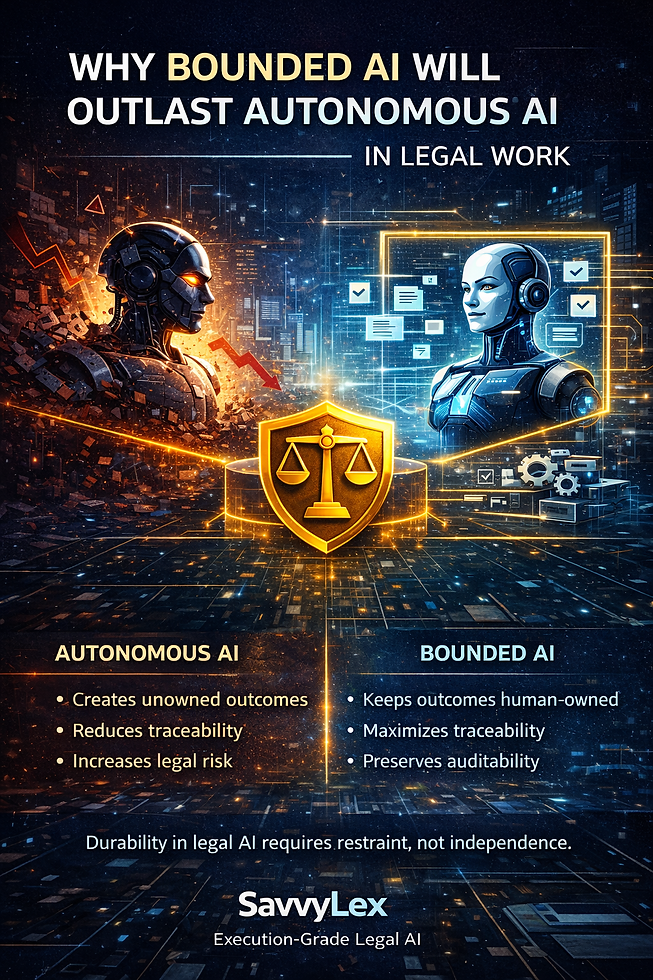
Why Bounded AI Will Outlast Autonomous AI in Legal Work
- SavvyLex

- Jan 4
- 3 min read
Why Bounded AI Will Outlast Autonomous AI in Legal Work
AI systems are increasingly being designed for autonomy. In legal work, that design direction creates a structural mismatch.
Legal practice depends on responsibility, attribution, and explainability. Legal outcomes must be traceable to a human decision-maker who can justify the reasoning, identify the supporting sources, and confirm the scope of what was reviewed. Autonomy optimizes for independent action. Legal systems optimize for accountable action.
This difference is not philosophical. It is operational. It determines whether an AI-enabled workflow can remain defensible under scrutiny.
Autonomy and Legal Risk
Autonomy introduces legal risk in predictable ways. The risk is not limited to “wrong answers.” The deeper issue is that autonomy can weaken the control mechanisms that make legal work reliable.
Common failure modes include:
Unowned outcomes
When AI-driven outputs feel “self-produced,” responsibility becomes diffuse. Teams assume someone else reviewed it. The system’s output is treated as a conclusion rather than a draft.
Reduced traceability
Autonomous behavior often hides the chain of reasoning and the specific sources used. When a result cannot be traced, it cannot be defended.
Informal verification
Autonomy can normalize skipping review. Verification becomes optional, inconsistent, or delegated to the least equipped reviewer.
Scope uncertainty
Users may not know what the system did not see. Gaps in jurisdictional coverage, missing authority, or incomplete records can go undisclosed.
These are not edge cases. They are structural incentives created by autonomous design.
What Bounded AI Means in Practice
Bounded AI is not “less capable.” It is designed for environments where accountability is non-negotiable.
A bounded system is defined by explicit limits:
Drafts, not decisions
The system produces working material that requires human adoption, revision, or rejection.
Sources visible by default
The system surfaces citations and makes it clear what authority supports each claim.
Clear scope and refusal boundaries
The system does not improvise outside its defined remit. When a task exceeds scope, it refuses or escalates.
Review checkpoints embedded in workflow
Human validation is not a suggestion. It is a required step.
Audit-ready outputs
The workflow preserves enough traceability to explain what happened, why it happened, and who approved it.
Boundaries create defensibility. They keep the human role explicit rather than implied.
Why Regulated Domains Demand Boundaries
Legal work is performed inside an institutional environment with professional obligations and external scrutiny. Courts, regulators, clients, and professional responsibility rules assume that legal conclusions can be explained and attributed.
A defensible workflow requires:
a clear human owner for each output
an identifiable set of sources used
a documented review standard
an understanding of what the system could not access or did not retrieve
Autonomous systems tend to erode these requirements because they optimize for continuity of output. Bounded systems preserve these requirements because they optimize for accountability.
Over time, the systems that survive in regulated legal environments will not be the ones that appear most independent. They will be the ones that are easiest to audit, explain, and govern.
The Durable Design Choice
As markets fluctuate and narratives shift, the legal standard remains stable: outcomes must be owned and defensible.
Autonomy increases speed, but it can also increase ambiguity. Ambiguity is where legal risk accumulates.
Bounded AI reduces ambiguity by design. It aligns AI behavior with institutional expectations: traceability, review, and accountable decision-making.
Conclusion
The long-term future of legal AI is not autonomous.
It is bounded, traceable, and owned.
Systems built around explicit limits will outlast systems built around independence, because defensibility is the requirement that does not change when technology does.
SavvyLex documents execution-grade legal AI workflows designed to remain defensible as technology, regulation, and market conditions evolve.


Comments