Why Most Legal AI Failures Happen Before the Model Is Ever Used
- SavvyLex

- Jan 10
- 2 min read
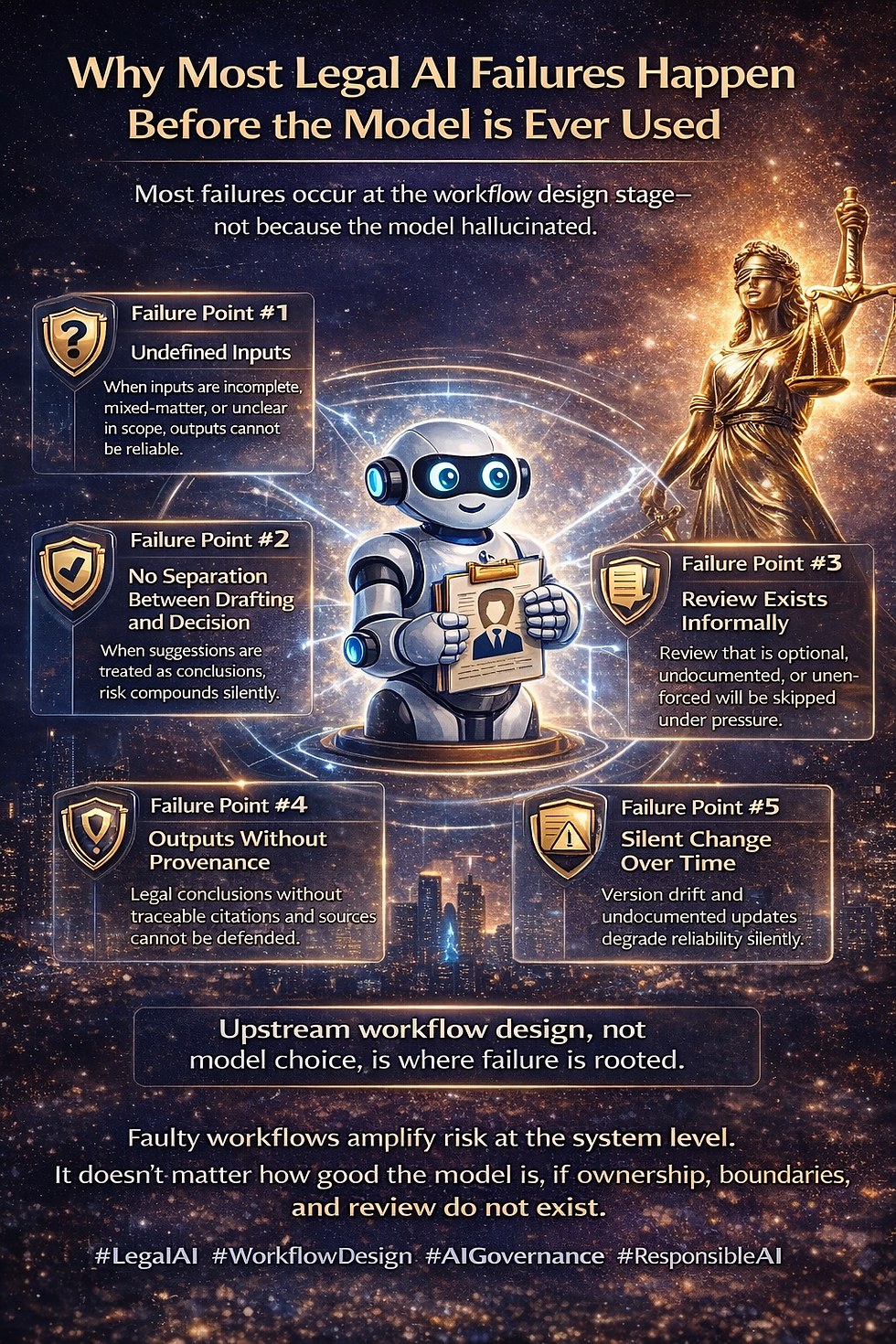
When legal AI systems fail, the blame is usually placed on the model.
Hallucinations, inaccuracies, or lack of sophistication are cited as the root cause.
In most cases, this diagnosis is wrong.
The majority of legal AI failures occur before the model is ever used, at the workflow design stage. The system behaves exactly as the process allows it to behave.
What fails is not intelligence.
What fails is structure.
The Wrong Failure Narrative
Legal AI is often evaluated in isolation: model choice, prompt quality, response accuracy.
But AI does not operate in a vacuum. It operates inside workflows that define:
what information it receives
how outputs are used
who reviews them
who is accountable for the result
When those elements are weak or undefined, failure is inevitable regardless of model quality.
Failure Point #1: Undefined Inputs
Many legal AI workflows begin with incomplete or poorly defined inputs:
mixed matters in a single document set
unclear jurisdictional scope
missing factual records
unverified source materials
When inputs are undefined, outputs cannot be reliable.
AI cannot compensate for missing context unless the workflow enforces completeness. If the system is not required to confirm what it has and what it does not, risk is silently introduced at the first step.
Failure Point #2: No Separation Between Drafting and Decision
A common design flaw is treating AI outputs as decisions rather than drafts.
When workflows do not clearly distinguish between:
generating material
evaluating material
approving material
users naturally over-rely on the output.
Speed creates confidence.
Confidence replaces judgment.
Without explicit boundaries, suggestions are mistaken for authority.
Failure Point #3: Review Exists in Culture, Not in Structure
Many teams rely on informal review norms:
“We always check AI output.”
In practice, review that is:
optional
undocumented
unenforced
will be skipped under time pressure.
AI accelerates workflows. Acceleration exposes weak controls.
If review is not structurally required by the system, it will not be consistently performed.
Failure Point #4: Outputs Without Provenance
Legal conclusions without provenance are indefensible.
When AI outputs lack:
identifiable sources
citation visibility
retrieval scope clarity
there is no way to explain how a result was reached or what authority supports it.
Confidence without traceability is the most dangerous failure mode in legal AI.
Failure Point #5: Silent Change Over Time
Legal AI systems evolve continuously:
models are updated
prompts drift
data sources change
Yet many workflows lack:
version control
regression testing
documented release processes
Reliability degrades gradually until a visible incident forces intervention.
Silent change undermines trust even when no single error appears catastrophic.
What This Means in Practice
Safe adoption of legal AI does not begin with:
choosing a better model
refining prompts
adding post-hoc guardrails
It begins with workflow design.
Accountability, scope definition, review enforcement, source traceability, and change control must exist before AI is introduced.
AI amplifies whatever structure it is given.
If the structure is weak, the failure will be amplified as well.
Conclusion
When legal AI fails, the most important question is not:
“Why did the AI do this?”
It is:
“Why did the workflow allow it?”
SavvyLex documents execution-grade legal AI workflows designed to preserve accountability, auditability, and human control in regulated legal environments.


Comments